D2D Marketing: A Powerful Way to Reach Customers Directly
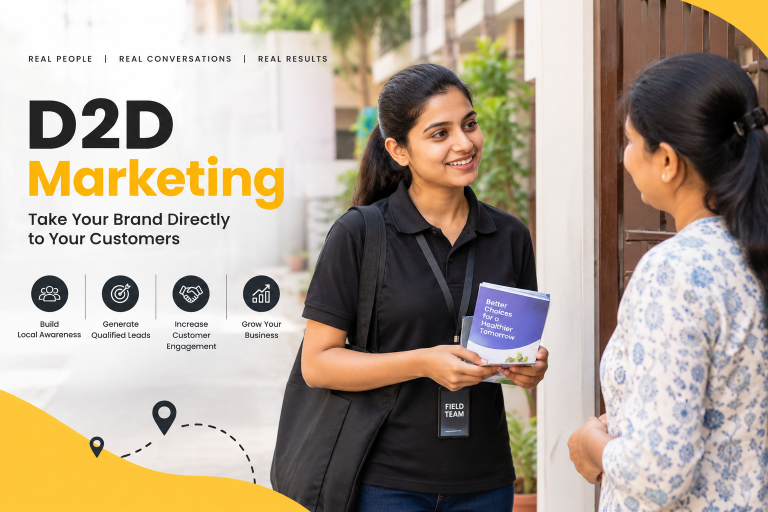
In a world where customers see hundreds of digital advertisements every day, getting genuine attention can be difficult. Door-to-Door (D2D) Marketing offers a more personal approach by taking your brand directly to potential customers.
Instead of waiting for customers to discover your brand online, D2D marketing allows trained representatives to visit homes, residential societies, shops, offices, and local communities to introduce products or services, answer questions, generate leads, distribute samples, and collect valuable customer feedback.
For brands looking to build awareness and generate leads at a local level, D2D marketing can be a powerful addition to their marketing strategy.
What Is D2D Marketing?
D2D marketing, also known as door-to-door marketing, is a form of direct marketing where trained field representatives interact with potential customers personally.
Depending on the campaign objective, representatives may:
Introduce a product or service
Explain product features and benefits
Generate qualified leads
Distribute brochures and promotional materials
Conduct product sampling
Demonstrate products
Collect customer feedback
Promote special offers
Encourage registrations or enquiries
Support customer acquisition
The biggest advantage is the two-way communication. Customers can immediately ask questions, express concerns, and understand how the product or service can benefit them.
Why Is D2D Marketing Still Effective?
Digital marketing is important, but not every customer makes a decision after seeing an online advertisement. Some products and services require explanation, demonstration, trust, or personal interaction.
D2D marketing brings the brand directly into the customer’s environment.
A trained representative can understand the customer’s requirement, explain the offering in a simple way, answer objections, and capture the customer’s interest for follow-up.
Modern D2D campaigns can also combine field activity with technology, digital lead capture, location-based planning, and campaign reporting, making the process more measurable than traditional door-to-door promotion.
Benefits of D2D Marketing
1. Direct Customer Interaction
D2D marketing creates personal conversations between your brand and potential customers. This allows representatives to understand customer requirements and communicate the right message.
2. Better Lead Generation
Instead of reaching a broad audience without knowing who is interested, field teams can identify interested customers and collect relevant information for follow-up.
3. Builds Local Brand Awareness
D2D campaigns are particularly useful when a business wants to establish visibility within a specific city, neighbourhood, society, town, or village.
4. Product Demonstration and Sampling
For products that customers need to see or experience, representatives can conduct demonstrations or distribute samples. This can help customers understand the product before making a purchase.
5. Real Customer Feedback
Face-to-face conversations provide an opportunity to understand customer opinions, questions, objections, preferences, and local market requirements.
6. Hyperlocal Targeting
Campaigns can be planned around specific areas and customer profiles instead of marketing to an entire population. This makes D2D particularly useful for local market expansion.
7. Supports Customer Acquisition
D2D campaigns can move customers from awareness to action through enquiries, registrations, appointments, demonstrations, trials, or sales follow-ups.
8. Creates Personal Trust
Human interaction can make a brand feel more approachable. A professional representative can explain the product and address questions immediately, helping create credibility.
Where Does D2D Marketing Work Best?
D2D marketing can work across urban, semi-urban, Tier 2, Tier 3, and rural markets, depending on the product, audience, and campaign objective.
Residential Societies
Gated communities and apartment complexes can be ideal for products and services aimed at families and households.
Examples include:
FMCG products
Healthcare services
Education
Broadband
Financial services
Home services
Consumer products
Local Markets
Busy markets can be useful for brands targeting shopkeepers, retailers, local consumers, or businesses.
D2D teams can conduct shop-to-shop visits, distribute promotional material, collect enquiries, and introduce new products.
Rural Markets
D2D marketing can help brands reach consumers in villages and rural communities where personal interaction and local communication can be important for building awareness.
Campaign messaging can be adapted according to local language, culture, purchasing behaviour, and market conditions.
Urban Neighbourhoods
For brands entering a new city or locality, D2D campaigns can create awareness within selected residential and commercial areas.
Corporate and Commercial Areas
Depending on the target audience, field teams can also engage working professionals, businesses, retailers, and decision-makers in commercial locations.
Fateh Rural specifically highlights residential societies, shopping malls, local markets, and corporate parks as high-impact environments for its activation campaigns.
When Should You Use D2D Marketing?
D2D marketing is particularly useful when your campaign requires direct communication and measurable local engagement.
1. During a New Product Launch
Launching a new product? D2D marketing can introduce it directly to your target audience through product explanation, sampling, demonstrations, and feedback.
2. When Entering a New Market
If your business is entering a new city, town, neighbourhood, or village, D2D marketing can help establish initial awareness among local customers.
3. When You Need Qualified Leads
If your objective is lead generation, field representatives can identify interested customers and collect information for sales follow-up.
4. For Product Sampling
FMCG, food, beauty, personal care, and consumer brands can use D2D campaigns to distribute samples and gather customer responses.
5. For Local Promotions
Businesses opening a new store, launching an offer, or promoting a service within a specific area can use D2D marketing to communicate directly with nearby customers.
6. For Customer Surveys and Feedback
D2D campaigns can also be used to collect market insights and understand customer preferences before or after launching a product.
7. For Customer Acquisition Campaigns
Businesses can use D2D campaigns to support registrations, enquiries, appointments, app downloads, subscriptions, and other customer actions.
Which Industries Can Use D2D Marketing?
D2D marketing can be adapted to many industries, including:
FMCG and Consumer Goods
Healthcare and Diagnostics
Education and EdTech
Real Estate
Banking and Financial Services
Insurance
Telecom and Broadband
Retail
Food and Beverage
Home Services
Beauty and Personal Care
Technology and Apps
Local Businesses
The campaign approach should be customized according to the product, target audience, geography, and desired outcome.
D2D Marketing vs Traditional Advertising
Traditional advertising helps a brand reach a large audience, but it may not always provide direct interaction with potential customers.
D2D marketing focuses on personal engagement.
For example, instead of simply showing an advertisement for a healthcare package, a trained representative can visit a target locality, explain the service, answer questions, and record an interested customer’s details.
This makes D2D particularly useful for products and services where trust, explanation, demonstration, or local presence matters.
How to Plan a Successful D2D Marketing Campaign
A successful campaign requires more than simply sending representatives from one house to another.
Step 1: Define Your Objective
Decide whether you want:
Brand awareness
Lead generation
Product sampling
Customer acquisition
App registrations
Enquiries
Surveys
Store visits
Product trials
Step 2: Identify Your Target Audience
Understand who your ideal customer is and where they are located.
Step 3: Map the Market
Select societies, neighbourhoods, markets, villages, towns, or commercial areas that match your target audience.
Step 4: Train the Field Team
Representatives should understand the product, campaign message, customer profile, FAQs, and appropriate communication approach.
Step 5: Prepare Marketing Materials
Depending on the campaign, this can include brochures, flyers, samples, coupons, QR codes, promotional merchandise, or demonstration materials.
Step 6: Track Leads and Engagement
Use structured data collection to record customer interactions, leads, feedback, and follow-up requirements.
Step 7: Measure Results
Review campaign reach, interactions, qualified leads, conversions, samples distributed, registrations, and other relevant KPIs.
Fateh Rural describes its activation process around requirement discussions, market mapping, strategy development, resource deployment, live execution, real-time tracking, and performance reporting.
Why Choose Professional D2D Marketing Services?
Managing a large field campaign internally can involve recruiting teams, training representatives, planning routes, monitoring activities, collecting data, and preparing reports.
A professional activation partner can manage these elements as an integrated campaign.
Fateh Rural offers professionally managed activation campaigns across urban and rural markets, with field teams, market mapping, lead capture, real-time monitoring, and campaign reporting as part of its activation approach.
Conclusion
D2D marketing is more than simply going from door to door. It is a strategic way to create personal connections, generate qualified leads, increase local awareness, collect customer insights, and support customer acquisition.
Whether you are launching a new product, entering a new market, promoting an offer, generating leads, conducting sampling, or building awareness in urban and rural communities, a well-planned D2D campaign can put your brand directly in front of the right audience.
When combined with proper market mapping, trained field teams, technology-enabled lead capture, and performance reporting, D2D marketing can become a valuable part of an integrated marketing campaign.