Van Campaign Marketing: Benefits, Best Locations, and When Your Business Should Use It
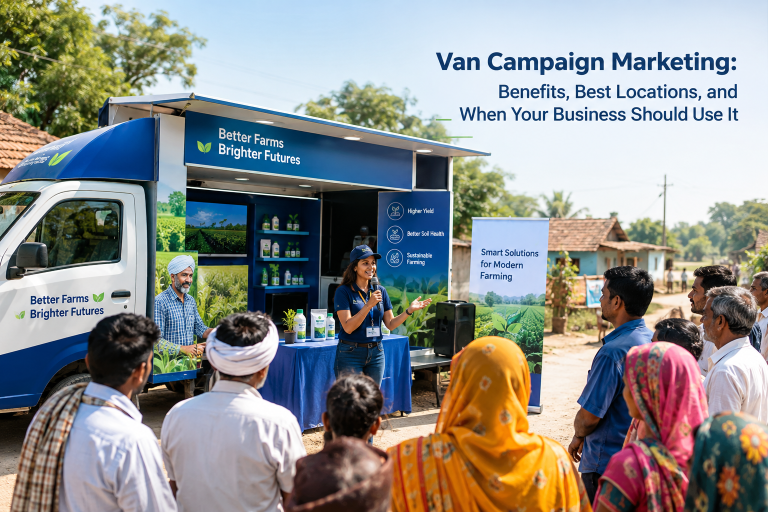
How do you reach customers who may never see your digital advertisements, visit your website, or walk into a branded showroom?
For many businesses, the answer is van campaign marketing.
Van campaigns take your brand directly to the people you want to reach. Instead of waiting for potential customers to discover your product, a branded promotional vehicle travels through selected villages, towns, residential areas, and local markets to create awareness and encourage direct interaction.
Unlike conventional outdoor advertising, a van campaign can do much more than display a brand logo. It can include live product demonstrations, free sampling, promotional announcements, interactive games, local events, and lead collection.
For brands entering new markets or trying to strengthen their presence in existing ones, van campaign marketing offers a practical way to connect with customers face-to-face.
What Is Van Campaign Marketing?
Van campaign marketing is an on-ground promotional strategy in which a specially branded vehicle travels through selected locations to promote a company’s products, services, or initiatives.
These vehicles can be equipped with sound systems, microphones, LED screens, product displays, promotional materials, and demonstration areas, depending on the campaign’s objectives.
A campaign may focus on brand awareness, product launches, customer education, sampling, lead generation, dealer engagement, or sales enquiries.
For example, an agricultural equipment company could take a promotional van to farming communities, demonstrate its latest machinery, explain its benefits in the local language, and collect enquiries from interested farmers.
Similarly, an FMCG brand could distribute product samples in local markets, while a solar energy company could explain its solutions and register interested households.
At Fateh Rural, van campaigns can be planned around a brand’s target audience, geographic coverage, promotional objectives, and field execution requirements. Campaigns can also incorporate activities such as farmer meetings, product demonstrations, sampling, announcements, and street plays.
7 Key Benefits of Van Campaign Marketing
1. Reach Customers Beyond Traditional Advertising
Digital advertising and traditional media cannot always reach every customer effectively, particularly in remote villages and smaller towns.
A mobile promotional vehicle can travel through selected areas and bring your message directly to the intended audience.
This makes van campaigns useful for businesses looking to increase visibility in rural markets, semi-urban locations, local trading centres, and underserved geographic areas.
2. Build Stronger Brand Awareness and Recall
A professionally branded van creates repeated visual exposure as it travels through local routes and stops at busy locations.
When this visibility is combined with announcements, demonstrations, and face-to-face interaction, customers get more opportunities to recognise and remember the brand.
Repeated exposure across carefully selected locations can help businesses establish a stronger local presence.
3. Demonstrate Products in Real-Life Situations
Some products are easier to understand when customers can see how they work.
A van campaign provides a mobile platform for product demonstrations and interactive experiences.
For example:
- Agricultural brands can demonstrate seeds, fertilisers, crop-care solutions, and farming equipment.
- Solar companies can explain solar products and their practical applications.
- Consumer goods brands can offer samples and explain product features.
- Automobile and tyre companies can showcase product benefits and collect enquiries.
Live demonstrations allow customers to ask questions and understand a product before making a purchase decision.
4. Generate Leads and Customer Enquiries
Van campaigns can support lead generation when the field team has a clear process for identifying and recording interested prospects.
Promoters can collect customer details, conduct short surveys, register product enquiries, arrange demonstrations, or connect interested people with local dealers and sales representatives.
Digital lead forms can make it easier to record information and organise follow-up activities.
The real value comes after the interaction: sales teams need to contact qualified prospects, answer questions, and move interested customers towards a purchase.
5. Adapt Your Message to Local Audiences
India’s markets differ in language, culture, buying habits, and local needs.
A campaign designed for one region may not work equally well in another.
Van campaigns allow brands to adapt their communication through regional languages, locally relevant examples, appropriate promotional activities, and location-specific messaging.
For rural marketing, this can make product communication easier to understand and more relevant to the people being addressed.
6. Support Product Launches and Market Expansion
Launching a new product requires more than announcing its availability. Potential customers may need to understand the product, its benefits, its price, and where they can purchase it.
A van campaign can introduce a product to new markets, create local awareness, distribute samples, and direct interested customers to nearby retailers or dealers.
It can also help businesses explore demand in selected locations before expanding their distribution network more widely.
7. Measure Campaign Execution and Field Activity
A well-planned campaign should have clear objectives and a reporting process.
Depending on the execution model, businesses can monitor:
- Locations and villages covered.
- Number of campaign days and vehicle deployment.
- Customer interactions and samples distributed.
- Leads and enquiries collected.
- Product demonstrations conducted.
- Follow-up outcomes and sales conversions.
Daily reports, photographs, attendance records, and digital lead data can help marketing teams assess whether campaign activities are being completed as planned.
These measures do not automatically guarantee sales, but they provide useful information for evaluating campaign performance.
Where Does Van Campaign Marketing Work Best?
Van campaigns are most effective when the vehicle, activities, and route are matched to the audience and the campaign objective.
1. Rural Villages and Agricultural Markets
Rural areas are an important market for agricultural inputs, machinery, animal healthcare, solar solutions, and other products relevant to farming communities.
A van can visit selected villages, coordinate farmer meetings, organise demonstrations, and communicate product information in local languages.
Best suited for: Seeds, fertilisers, crop protection, tractors, farm equipment, veterinary products, and rural financial services.
2. Small Towns and Semi-Urban Markets
Smaller towns can offer opportunities for businesses expanding beyond major cities.
Promotional vehicles can cover local markets, commercial areas, neighbourhoods, and selected community locations to introduce products and create awareness.
Best suited for: FMCG, home appliances, consumer electronics, personal care, automobiles, and retail businesses.
3. Weekly Markets and Local Fairs
Weekly markets and community fairs can bring together people from nearby villages and neighbourhoods.
With appropriate permissions and a suitable location, a campaign van can support product sampling, demonstrations, promotional activities, and customer registrations.
Best suited for: Food and beverage brands, household products, agricultural solutions, and consumer-focused services.
4. Residential Societies and Urban Neighbourhoods
Van campaigns are not limited to rural India. They can also be used in urban locations where direct interaction is valuable.
Brands may conduct society activations, product demonstrations, sampling drives, and promotional events, subject to venue permissions and local requirements.
Best suited for: Packaged foods, household products, home services, education, and selected consumer brands.
5. Dealer and Distributor Networks
Manufacturers often need to support local dealers while building demand for their products.
A mobile campaign can visit multiple markets, direct customers to authorised dealers, explain product features, and collect enquiries for the local sales team.
Best suited for: Agricultural machinery, tyres, automobiles, electrical products, building materials, and industrial products with local distribution networks.
6. New Market Entry Across Multiple States
Businesses entering new regions may need to introduce their products to audiences with different languages, preferences, and purchasing habits.
A geographically planned van campaign can help establish initial visibility, facilitate customer interactions, and gather feedback from selected markets.
Best suited for: National brands, new product launches, distribution expansion, and regional market development.
When Should Your Business Invest in a Van Campaign?
Van campaign marketing is worth considering when your business has a specific audience to reach and a clear reason to interact with that audience in person.
Here are six situations where it can be particularly useful.
1. When launching a new product
Use a van campaign to introduce the product, explain its benefits, offer samples or demonstrations, and direct potential customers towards purchase channels.
2. When entering a new geographic market
If your brand is expanding into new districts, towns, or villages, a targeted campaign can help introduce the business and assess customer interest.
3. When customers need product education
Products that involve technical features, unfamiliar benefits, or questions about usage may benefit from demonstrations and direct conversations.
4. When digital advertising alone is insufficient
If your intended audience is difficult to reach through digital channels, or if physical product interaction is important, an on-ground campaign can complement your online marketing.
5. When supporting seasonal demand
Agricultural products, monsoon-related solutions, festive offers, and other seasonal products may benefit from campaigns scheduled around relevant buying periods.
Timing should reflect local demand, weather, crop cycles where applicable, and the availability of the product.
6. When building a local dealer or retailer network
A campaign can create awareness around a new dealer, communicate local offers, and direct interested customers to nearby points of sale.
The strongest results are more likely when the campaign is connected to product availability, sales follow-up, and a clear customer conversion process.
What Types of Van Campaigns Can Businesses Choose?
Different campaigns require different vehicles and equipment. The right choice depends on the audience, route, activities, and budget.
Basic Promotional Van
A practical option for broad awareness campaigns, local announcements, sampling, and promotional drives across multiple locations.
L-Shape Experiential Van
Designed for campaigns that need a more interactive setup, such as product displays, promotional games, demonstrations, and small-scale engagement activities.
LED Screen Van
Useful for displaying video content, advertisements, product information, and launch presentations in suitable locations.
Customised Promotional Truck
A larger branded platform for extensive product displays, experiential activities, and campaigns that require a more elaborate mobile setup.
Additional activities may include street plays (nukkad natak), farmer meetings, promotional games, sampling, announcements, and promoter-led data collection.
The final setup should be chosen according to the campaign objective rather than vehicle size alone.
How to Plan a Successful Van Campaign
A successful campaign starts with a clear strategy, not simply a branded vehicle.
Step 1: Define the objective
Decide whether the primary goal is brand awareness, product education, lead generation, sampling, dealer support, or sales.
Step 2: Identify the target audience
Define who you want to reach, where they are located, what they need to know, and what action you want them to take.
Step 3: Map the campaign locations
Select villages, towns, markets, residential areas, or dealer territories based on audience concentration, accessibility, and commercial relevance.
Step 4: Design the campaign experience
Choose the appropriate vehicle, branding, language, audio-visual material, product demonstrations, and engagement activities.
Step 5: Prepare the field team
Brief promoters and campaign staff on product information, customer interaction, data collection, safety, and reporting procedures.
Step 6: Monitor execution
Track vehicle deployment, completed locations, campaign activities, and lead quality. Check that branding and promotional materials are maintained throughout the campaign.
Step 7: Measure the results
Compare campaign outcomes with the original objectives. Evaluate relevant measures such as customer interactions, qualified leads, cost per lead, dealer enquiries, and attributable sales where reliable data is available.
This process helps businesses understand what worked, where improvements are needed, and whether the campaign should be repeated or expanded.
Van Campaign Marketing vs Digital Advertising
Van campaigns and digital advertising serve different purposes, so the better choice depends on your marketing objective.
| Factor | Van Campaign Marketing | Digital Advertising |
|---|---|---|
| Customer interaction | Face-to-face engagement | Primarily online interaction |
| Product demonstration | Can support live demonstrations | Usually uses video, images, or interactive content |
| Geographic targeting | Selected routes and physical locations | Selected locations and online audiences |
| Lead generation | Field enquiries and registrations | Forms, calls, messages, and website enquiries |
| Audience reach | Depends on routes, duration, and footfall | Depends on budget, targeting, and platform delivery |
| Best use | Local activation, product education, and physical engagement | Online discovery, website traffic, and digital lead generation |
For many businesses, combining both approaches can be more useful than choosing only one.
For example, a brand can run a van campaign in selected villages while using digital advertising to reinforce awareness in the same region. QR codes, campaign-specific landing pages, and dedicated enquiry numbers can help connect physical interactions with online follow-up.
How Much Does a Van Campaign Cost?
The cost of a van campaign depends on the scope and complexity of the activity.
Common cost factors include:
- Type and number of vehicles.
- Campaign duration and travel distance.
- Vehicle branding and customisation.
- Audio equipment, LED screens, or demonstration facilities.
- Promoters, field coordinators, and other staff.
- Sampling materials, promotional items, and event activities.
- Permissions, logistics, accommodation, and reporting requirements.
A short local campaign and a multi-state roadshow will have very different cost structures.
Instead of selecting a campaign solely on the lowest quoted price, businesses should compare the locations covered, duration, team deployment, included activities, reporting standards, and expected campaign outcomes.
Requesting a detailed proposal based on the campaign objective and target geography is the best way to estimate the investment.
Why Choose Fateh Rural for Van Campaign Marketing?
Planning and executing a van campaign across different markets requires coordination between strategy, creative production, vehicle deployment, local teams, and field reporting.
Fateh Rural offers roadshows and van campaigns designed to help brands connect with rural and urban audiences across India.
Depending on the project requirements, campaign execution can include:
- Campaign planning: Defining objectives, target audiences, and geographic coverage.
- Route planning: Identifying relevant locations and organising the campaign schedule.
- Vehicle branding: Preparing branded vehicles suited to the campaign.
- On-ground activation: Supporting demonstrations, sampling, announcements, farmer meetings, and other promotional activities.
- Field monitoring: Tracking execution and collecting campaign evidence.
- Reporting: Reviewing locations covered, activities completed, leads collected, and other agreed performance indicators.
The campaign can be structured around your industry, target market, promotional requirements, and available budget.
Explore the service: Fateh Rural Van Campaigns
Frequently Asked Questions
1. What is the main purpose of a van campaign?
The main purpose is to take a brand’s message directly to its target audience through mobile advertising, on-ground engagement, product demonstrations, sampling, or lead generation.
2. Which industries benefit most from van campaigns?
Agriculture, FMCG, automobiles, tyres, solar energy, veterinary products, consumer goods, and financial services can benefit when their target customers are well suited to face-to-face promotion.
3. Are van campaigns useful for rural marketing?
Yes. They can help brands reach selected villages and smaller towns, communicate in local languages, organise farmer meetings, demonstrate products, and generate customer enquiries.
4. Can van campaigns generate leads and sales?
They can generate enquiries and support sales, particularly when promoters capture customer details and the sales team follows up promptly. Actual conversions depend on product relevance, pricing, distribution, campaign execution, and follow-up.
5. How long should a van campaign run?
The duration depends on the number of locations, travel distances, campaign objectives, and target audience. A local activation may require only a short deployment, while a wider regional or national campaign may need several weeks or longer.
6. Can a van campaign include product demonstrations and sampling?
Yes. Depending on the vehicle and campaign design, activities can include product demonstrations, sampling, promotional games, announcements, LED displays, and customer registrations.
7. How can a business measure van campaign performance?
Businesses can track locations covered, campaign days completed, customer interactions, samples distributed, qualified leads, cost per lead, and attributable sales where tracking is available.
Conclusion: Take Your Brand Closer to Your Customers
Reaching the right customers requires more than visibility. It requires relevant communication, suitable locations, and a clear next step for people who show interest in your product.
Van campaign marketing gives businesses a flexible way to bring their products and messages directly to communities, local markets, and potential customers. With careful planning, the right field activities, and consistent reporting, it can support brand awareness, product education, lead generation, and market expansion.
If your business is planning a product launch, rural outreach programme, dealer activation, or multi-location promotional campaign, a well-planned van campaign could be a valuable part of your marketing strategy.
Planning your next campaign?
Connect with Fateh Rural to discuss your target audience, campaign locations, vehicle requirements, and execution plan.